DSPE-PEG and DMG-PEG are PEG-lipids used in lipid nanoparticle (LNP) formulation research, but they differ in lipid anchor structure and generally show different PEG retention behaviors. DSPE-PEG contains two C18 stearoyl chains attached to a phospholipid backbone, whereas DMG-PEG contains two shorter C14 myristoyl chains attached to a glycerol-based lipid structure.
The key formulation difference is PEG shedding: DSPE-PEG generally associates more strongly with lipid assemblies and may remain in LNPs longer, while DMG-PEG is generally more readily released from the particle. DSPE-PEG may therefore be worth evaluating when longer PEG retention is required, whereas DMG-PEG may be suitable when a more transient PEG layer is desired. Neither option is universally better; the preferred lipid depends on the cargo, formulation composition, and intended delivery behavior.
For researchers developing mRNA, siRNA, or other nucleic acid delivery systems, understanding the relationship between lipid anchor structure and PEG retention helps guide material selection and experimental design. SinoPEG provides a range of PEGylated lipids for formulation research, including DSPE-based derivatives with different PEG molecular weights and terminal functional groups.
What Is the Structural Difference Between DSPE-PEG and DMG-PEG?
Both materials combine a hydrophobic lipid anchor with a hydrophilic polyethylene glycol (PEG) chain. The lipid portion associates with the lipid phase of the nanoparticle, while the PEG chain extends toward the aqueous environment and influences the particle's surface properties.
DSPE-PEG is based on distearoyl phosphatidylethanolamine (DSPE), which contains two saturated C18 fatty acyl chains and a phospholipid headgroup. DMG-PEG is based on dimyristoyl glycerol (DMG), which contains two saturated C14 fatty acyl chains and a glycerol-based structure.
| Feature | DSPE-PEG | DMG-PEG |
|---|---|---|
| Lipid structure | Distearoyl phosphatidylethanolamine | Dimyristoyl glycerol |
| Hydrophobic chains | Two C18 chains | Two C14 chains |
| General lipid anchoring | Generally stronger association with lipid assemblies | Generally more readily released from lipid assemblies |
| PEG retention tendency | Often longer-lasting | Often more transient |
| Potential formulation objective | Maintaining PEG coverage for longer | Allowing more rapid PEG shedding |
These are general tendencies, not guaranteed outcomes. PEG molecular weight, lipid molar fraction, nanoparticle composition, preparation method, and the surrounding biological environment can all influence the actual behavior of a PEG-lipid.

DSPE-PEG-OH: an example of a DSPE-based PEG-lipid structure.
How Does Lipid Anchor Length Affect PEG Shedding?
Lipid anchor length influences how strongly a PEG-lipid associates with the lipid phase of a nanoparticle. Under otherwise comparable conditions, longer saturated hydrocarbon chains generally provide stronger hydrophobic interactions than shorter chains.
Because DSPE-PEG contains two C18 chains, it generally shows stronger association with lipid assemblies than DMG-PEG, which contains two C14 chains. This difference can affect how readily each material leaves an LNP after formulation.
PEG shedding refers to the loss or desorption of PEG-lipid from a nanoparticle over time. It changes the extent of PEG coverage at the particle surface and can influence interactions with proteins, cells, and other biological components.
A more persistent PEG layer may help maintain steric stabilization, while faster shedding may expose more of the particle surface. However, faster PEG shedding does not automatically mean better delivery. The optimal balance depends on the specific LNP design and the intended biological endpoint.
For projects involving functionalized PEG-lipids, researchers can also review SinoPEG's DSPE-PEG-X product range to explore DSPE-based materials with different terminal functionalities. These products can be relevant when a formulation requires a specific reactive group, although the suitability of each derivative must be evaluated for the intended application.
Why PEG Retention Matters in LNP Formulation Design
PEG-lipids are commonly used in lipid nanoparticle systems to influence surface characteristics, colloidal stability, and interactions with biological environments. Their role is not limited to particle formation; the duration of PEG coverage can also matter after administration.
For nucleic acid delivery, the PEG layer can help reduce certain nonspecific interactions. However, persistent surface PEG may also hinder some interactions between nanoparticles and cells. Changes in PEG coverage may therefore affect cellular uptake and other stages of delivery.
DSPE-PEG and DMG-PEG offer different starting points for balancing these requirements:
- DSPE-PEG: Consider evaluating it when a more persistent PEG layer is desired.
- DMG-PEG: Consider evaluating it when more rapid PEG shedding is part of the formulation strategy.
- Either material: Confirm its suitability through stability testing, PEG-retention measurements, and functional delivery assays.
PEG shedding is only one factor in LNP performance. Particle uptake, endosomal escape, cargo release, biodistribution, and biological activity depend on multiple formulation and biological variables. A change in PEG retention should therefore be interpreted alongside the performance of the complete delivery system.
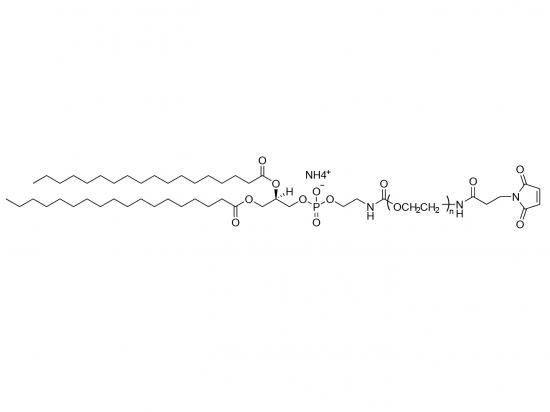
DSPE-PEG-MAL: an example of a functionalized DSPE-PEG derivative.
How Should Researchers Choose Between DSPE-PEG and DMG-PEG?
The most useful starting point is to define what the PEG-lipid needs to accomplish in the formulation. Rather than selecting a material based on chain length alone, researchers should consider the required surface retention, particle stability, cargo type, and delivery objective.
When longer PEG retention is the priority
DSPE-PEG may be a useful candidate when the formulation requires a more persistent PEG layer. Its longer C18 chains generally provide stronger lipid anchoring. Researchers should verify that this behavior supports the desired stability and biological performance rather than assuming that longer retention is always advantageous.
When more rapid PEG shedding is the priority
DMG-PEG may be worth screening when the formulation is designed to lose PEG more readily over time. The extent and timing of shedding should be measured under conditions relevant to the intended research model.
When the preferred behavior is uncertain
A controlled comparison of both materials can help identify which one better meets the project's requirements. Use the same cargo, ionizable lipid, helper lipid, cholesterol, preparation method, and testing conditions wherever possible. Adjusting several variables simultaneously makes it difficult to attribute performance differences to the PEG-lipid itself.
The best choice may also differ between mRNA and siRNA formulations, or between in vitro and in vivo research. Results from one formulation should not be treated as universal evidence for all LNP systems.
Which Parameters Should Be Measured During PEG-Lipid Screening?
A meaningful DSPE-PEG versus DMG-PEG comparison should examine both physical properties and functional performance. The following measurements can help researchers understand whether a change in lipid anchor structure produces a useful formulation outcome.
- Particle size: Determine whether the PEG-lipid changes the average hydrodynamic diameter of the LNP.
- Polydispersity index (PDI): Assess the breadth of the particle size distribution.
- Encapsulation efficiency: Measure the proportion of nucleic acid cargo encapsulated by the formulation.
- PEG-lipid retention: Determine how much PEG-lipid remains associated with the particles over time.
- Colloidal and storage stability: Monitor changes in particle size, PDI, and other relevant characteristics during storage or exposure to test media.
- Cellular uptake and functional delivery: Evaluate whether differences in surface properties affect the intended biological outcome.
- Biological compatibility: Assess relevant toxicity and tolerability endpoints for the intended experimental model.
PEG molecular weight and PEG-lipid molar percentage should be controlled during comparisons. For example, comparing DSPE-PEG2000 and DMG-PEG2000 can help keep the nominal PEG molecular weight consistent while examining the influence of the lipid anchor.
Even in this comparison, actual PEG shedding should be measured rather than inferred from molecular structure alone. Differences in the remaining lipid components, particle preparation, and test environment may alter the outcome.
How SinoPEG PEG-Lipids Fit Into LNP Research
PEG-lipid selection is one part of a broader formulation development process. Researchers may also need to select an appropriate terminal group, PEG molecular weight, lipid composition, purity specification, and analytical documentation.
SinoPEG's lipid portfolio includes DSPE-based PEG derivatives and other lipid materials for research and formulation development. For example, DSPE-PEG derivatives with different terminal groups may be relevant when researchers need to investigate surface modification or conjugation strategies.
Example of a functionalized PEG-lipid structure for research applications.
Researchers can explore SinoPEG's lipid product portfolio when identifying materials for their formulation projects. Product selection should be based on the exact chemical identity, molecular weight, terminal functionality, specifications, and compatibility with the intended application.
When requesting material information, it is helpful to provide the target PEG molecular weight, required functional group, intended research application, purity requirements, and desired analytical documentation. These details can help narrow down suitable candidates before experimental screening.
Conclusion: Which PEG-Lipid Is Better for LNP Formulation?
DSPE-PEG and DMG-PEG differ primarily in their hydrophobic lipid anchors. DSPE-PEG contains two C18 stearoyl chains and generally associates more strongly with lipid assemblies, while DMG-PEG contains two shorter C14 myristoyl chains and is generally more readily shed from LNPs.
Choose DSPE-PEG as a candidate when longer PEG retention is desired; evaluate DMG-PEG when more rapid PEG shedding is desired. This is a starting point for formulation design, not a universal performance rule.
The final decision should be based on measured PEG retention, particle stability, encapsulation efficiency, and functional delivery performance. Controlled comparisons provide more reliable evidence than relying on anchor structure alone.
Frequently Asked Questions
What is the main difference between DSPE-PEG and DMG-PEG?
DSPE-PEG contains two C18 stearoyl chains in a phospholipid structure, while DMG-PEG contains two shorter C14 myristoyl chains in a glycerol-based structure. This difference generally influences lipid anchoring and PEG retention.
Which PEG-lipid stays in LNPs longer?
DSPE-PEG generally shows longer retention because its C18 chains provide stronger association with lipid assemblies. DMG-PEG is generally more readily shed, although actual retention depends on the formulation and test conditions.
Is DMG-PEG better than DSPE-PEG for mRNA delivery?
Not in every formulation. DMG-PEG may be useful when more rapid PEG shedding is desired, whereas DSPE-PEG may be useful when longer PEG retention is required. Functional delivery studies are needed to determine which material performs better in a particular system.
Does PEG molecular weight affect LNP performance?
Yes. PEG molecular weight can influence the dimensions of the surface PEG layer and affect particle characteristics. It should be considered together with lipid anchor structure, PEG-lipid concentration, and the complete formulation.
Can DSPE-PEG and DMG-PEG be compared in the same experiment?
Yes. Researchers can compare the two materials under controlled conditions and measure particle size, PDI, encapsulation efficiency, PEG retention, stability, and functional delivery. Key formulation variables should remain consistent wherever possible.
What should researchers check when sourcing PEG-lipids?
Check the chemical identity, PEG molecular weight, terminal functionality, purity specifications, batch consistency, storage requirements, and available analytical documentation. Suitability for the intended research application should also be confirmed.
Scientific References
The following publications provide background on PEGylation, lipid nanoparticle design, and PEG-lipid desorption. The structural comparison and product-selection recommendations above should be validated against the requirements of each specific formulation.
- Suk JS, Xu Q, Kim N, Hanes J, Ensign LM. PEGylation as a strategy for improving nanoparticle-based drug and gene delivery. Advanced Drug Delivery Reviews. 2016;99(Pt A):28–51.
- Mui BL, Tam YK, Jayaraman M, et al. Influence of polyethylene glycol lipid desorption rates on pharmacokinetics and pharmacodynamics of siRNA lipid nanoparticles. Molecular Therapy—Nucleic Acids. 2013;2:e139.
- Hou X, Zaks T, Langer R, Dong Y. Lipid nanoparticles for mRNA delivery. Nature Reviews Materials. 2021;6:1078–1094.
- Wittrup A, Lieberman J. Knocking down disease: a progress report on siRNA therapeutics. Nature Reviews Genetics. 2015;16:543–552.
Research note: This article discusses general formulation principles and is not a substitute for application-specific experimental validation. Reference details and the relevance of each publication should be checked before publication.